
How To Clean Your Warehouse: A Professional Step-by-Step Guide
Warehouses are the engines behind businesses of all sizes, storing critical inventory and supporting daily operations. Yet, due to their scale and heavy use, keeping these environments clean and safe can be daunting. If you’re searching for detailed, practical guidance on how to clean your warehouse—including preparation, specific protocols, checklists, safety concerns, and tips on when to call in professionals—this comprehensive resource from Quick Cleaning is for you.
What Makes Warehouse Cleaning Unique?
Before you begin, it’s crucial to understand why warehouse cleaning demands a specialized, systematic approach. The sheer size of the space, presence of machinery, variety of stored items, and the high-traffic nature of loading docks and aisles create unique cleaning challenges. Risks include cross-contamination, unintentional spreading of debris, and workplace accidents from spills or obstructions. Efficient cleaning protects your stock, ensures employee safety, and maintains compliance with health regulations.
- Scale and accessibility – High shelves, racks, and hard-to-reach areas require the right tools and planning.
- Varied surfaces – Concrete floors, metal shelving, and mixed materials call for targeted cleaning products and methods.
- Health and safety – Dust, spills, and pest risks demand diligent cleaning routines, especially in food or medical supply warehouses.
- Operational continuity – Cleaning routines must fit seamlessly around ongoing warehouse logistics.
Essential Preparation: What to Do Before Cleaning a Warehouse
Preparation is critical. An effective warehouse cleaning plan starts well before any mop touches the floor. Here’s what you should always do first:
- Assess the facility: Walk through the entire warehouse, noting problem areas (spill-prone zones, dusty corners, clogged vents).
- Inventory your equipment: Ensure you have the right cleaning supplies—industrial vacuums, floor scrubbers, brooms, dusters, and the appropriate detergents. For EPA-registered disinfectants, see the EPA’s disinfectant list.
- Develop a cleaning checklist: Itemize tasks for daily, weekly, and monthly cleaning. (See our master checklist below.)
- Establish safety protocols: Ensure staff are equipped with proper PPE and are familiar with material safety data sheets (MSDS) for cleaning chemicals.
- Create a cleaning schedule: Align deep cleans and routine maintenance to avoid operational disruption.
Warehouse Cleaning Master Checklist
A detailed checklist minimizes oversight. Use the following as a template, adjusting to your specific site needs:
| Area/Item | Daily | Weekly | Monthly |
|---|---|---|---|
| Floors | Sweep, spot-mop spills | Machine scrub | Deep clean, reseal |
| Dusting of Surfaces | High-touch zones | Racks, shelves, vents | Ceilings, beams |
| Restrooms | Restock, sanitize | Deep cleaning | Disinfect fixtures |
| Loading Docks | Clear debris | Inspect for hazards | Pressure wash |
| Break Rooms | Wipe, disinfect surfaces | Clean appliances | Deep clean |
| Equipment | Wipe down | Sanitize touchpoints | Check for buildup/grease |
| Trash/Recycling | Empty bins | Sanitize bins | Deep clean storage areas |
| Windows/Doors | Spot clean glass | Clean frames/tracks | Full wash |
| Safety Signage | Check visibility | Clean/wipe | Replace if needed |
For a printable PDF version, adapt each item to your operation’s specifics.
Step-by-Step: How to Clean Your Warehouse Floor Safely
The warehouse floor experiences the most wear and presents specific safety and hygiene issues. Here’s a safe, effective sequence for thorough cleaning:
- Clear the area, removing loose items, pallets, and debris.
- Sweep with industrial brooms or vacuums, starting at far corners and moving toward main exits.
- Spot-clean spills immediately with suitable products for the type of liquid or residue involved.
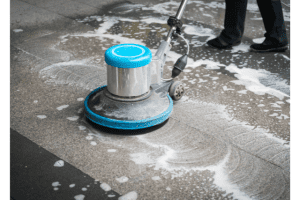
- Machine-scrub using an auto-scrubber and appropriate cleaning solution. For large stains, allow product to dwell for the recommended time.
- Rinse or wet-vac excess water, ensuring surfaces are dry to prevent slips.
- Inspect for damage (cracks, chipped sealing) and report as needed.
- Pro tip: For high-traffic corridors, increase the frequency of machine scrubbing (see high-traffic floor cleaning tips).
Cleaning High-Shelves and Hard-to-Reach Areas
Dust and debris on high racks, beams, or ductwork can contaminate inventory and affect air quality. Safe access and the right equipment are critical.
- Use long-handled dusters and extension tools when possible.
- For heights, deploy mobile scaffolds or lifts with trained staff (always follow OSHA guidelines).
- Work in pairs for safety during elevated tasks.
- Dispose of collected dust in sealed bags to prevent redistribution.
Sanitizing Restrooms, Break Rooms and Employee Areas
Shared areas require special attention for hygiene and morale. Here’s how to address them thoroughly:
- Restrooms: Daily restocking, disinfecting fixtures, touchpoints, handles and floors. Deep clean with EPA-registered disinfectants at least weekly (EPA disinfectant guidance).
- Break rooms: Clean tables, counters, and appliances. Disinfect refrigerators and microwaves to prevent odors and bacteria buildup.
- Employee lockers: Empty monthly, sanitize inside and out.
See our list of overlooked cleaning spots for more detail.
Addressing Specialized Zones: Loading Docks, Cold Storage, and Hazardous Areas
Some warehouse sections have distinct cleaning needs:
- Loading docks: Regular sweeping to remove dirt, trash and pallet debris. Pressure-wash surfaces as needed. Check for slip/trip hazards.
- Cold storage: Use food-safe cleaning products. Manage condensation and ice buildup to prevent slips and mold.
- Hazardous storage: Staff must use gloves, masks, and appropriate containment measures for chemical residue or spills. Follow manufacturer and facility protocols strictly.
Reducing Cross-Contamination in Your Warehouse
Warehouses often see cross-traffic between clean, dirty, and hazardous zones. To minimize contamination risks:
- Designate and color-code equipment for different zones (e.g., red for hazardous, green for food safe areas).
- Train staff on best practices for hand hygiene and chemical handling.
- Clean ‘clean to dirty’—start with cleaner spaces and move toward messier ones, changing equipment as needed.
- Review more cross-contamination tips in this in-depth guide.
How Often Should You Clean Your Warehouse? Frequency Guidance
The right cleaning frequency depends on your specific warehouse usage, traffic volume, and regulatory requirements.
- Daily: Trash removal, spill cleanup, restroom and entryway cleaning, high-touch zone disinfection.
- Weekly: Deep floor scrubbing, dusting racks and fixtures, machine and forklift cleaning.
- Monthly: Ceiling, duct, and high-beam dusting; gutter clearing; storage room and appliance disinfection.
- Annually: Comprehensive deep-clean of all surfaces, professional inspection for compliance.
For more on setting optimal cleaning schedules for commercial spaces, read this checklist.
Comparing DIY Warehouse Cleaning vs. Hiring Professional Cleaners
Should you handle warehouse cleaning with your own team or outsource to specialists? Consider these factors:
- Greater control over schedules and access
- Potential cost savings for small, low-traffic facilities
Limitations:
- Lack of training in industrial safety protocols
- Limited access to advanced equipment and EPA-registered products
- Risk of inconsistent results and non-compliance
Professional cleaning advantages:
- Trained staff familiar with OSHA, EPA and local health standards
- Ability to tackle large-scale and high-difficulty tasks (e.g. floor restoration, hazardous material cleanup)
- Liability coverage and reliable scheduling
See a more detailed comparison at industrial vs. commercial cleaning differences.
Best Practices for Warehouse Cleaning Safety
Every cleaning activity must place safety first. Concrete, metal, and chemical residues present unique risks in industrial environments.
- Always use personal protective equipment (PPE)—gloves, eyewear, masks, steel-toe boots as appropriate.
- Check cleaning product labels and follow application/dwell time recommendations.
- Use “Wet Floor” and hazard signage (OSHA-compliant).
- Store chemicals securely and keep materials safety data (MSDS) accessible.
- Train all cleaning team members in both general and facility-specific safety protocols. For established frameworks, review APIC infection control education.
Maintaining a Clean Warehouse: Organization, Storage & Prevention
Sustained cleanliness is easier with strong preventive systems. Adopt these strategies:
- Label and organize inventory to prevent unnecessary movement and clutter.
- Assign staff to ‘zone ownership’ to promote accountability.
- Regularly inspect pest control measures, especially for food-grade goods.
- Encourage a “clean as you go” culture—daily small actions add up.
Further insights on floor maintenance are available in our floor cleaning guide.
Documenting and Auditing Your Warehouse Cleaning Program
Routine documentation ensures tasks are completed and helps demonstrate regulatory compliance.
- Create daily/weekly logs for completed cleaning tasks.
- Keep checklists accessible to all cleaning and management staff.
- Schedule and record periodic safety inspections.
- Request feedback from warehouse teams to identify improvement areas.
Use cleaning documentation for insurance audits and workplace safety reviews as needed.
When to Schedule Deep Cleaning and Specialized Services
Some scenarios require more than standard cleaning routines:
- After construction or renovation work—professional post-construction cleaning is critical before reintroduction of inventory.
- Following pest infestation, major spills, or hazardous material exposure.
- If required by regulations or industry standards after audits.
- Change in warehouse use, such as switching to food-grade storage.
For special facility, post-construction or industrial-grade cleaning services, review what’s included at post-construction cleaning or reach out to Quick Cleaning directly.
Common Warehouse Cleaning Challenges and Solutions
Even with strong plans, warehouse managers often encounter persistent issues:
- Resurfacing dust and dirt: Review ventilation and filter maintenance schedules to help prevent recurring buildup.
- Pest infestations: Coordinate with pest control and ensure food/organic waste is properly managed and removed daily.
- Persistent odors: Clean drains and garbage areas weekly; use odor-neutralizing, EPA-approved cleaning products.
- Stained or damaged floors: Address spills quickly to avoid permanent marks. Schedule periodic deep floor restoration or sealing as needed.
Warehouse Cleaning FAQ
- What cleaning supplies are safe for use in a warehouse?
- Use industrial-strength products suited to your warehouse surfaces and inventory. Refer to the EPA list of disinfectants for sanitizing areas. Always check that products are compatible with the materials in your facility.
- How long does it take to clean a large warehouse?
- Time varies widely with warehouse size, condition, and cleaning scope. Routine maintenance may take 2–4 hours daily, with deep cleaning or special projects requiring more extensive effort, especially if equipment or specialized staff are needed.
- How do you clean hard-to-reach or elevated areas?
- Utilize extension dusters and, when needed, mobile scaffolds or lifts. Staff must be trained in proper use and safety protocols before cleaning at height.
- What is the risk of cross-contamination in a warehouse?
- Cross-contamination arises when equipment or staff transfer dirt, debris, or microbes between different warehouse zones. Minimize risk with zone-specific supplies and clear staff training; for detailed strategies, see this cross-contamination guide.
- Should I outsource warehouse cleaning or use my staff?
- For routine surface cleaning, trained in-house teams may suffice. For deep cleaning, hazardous material, or compliance-driven projects, third-party professionals (like Quick Cleaning) offer specialized skills, better equipment, and assurance of regulatory compliance.
- Are there regulations on cleaning warehouses?
- Yes, warehouses must meet OSHA, EPA, and local public health requirements. Certain inventory types (food, medical, hazardous materials) have specific sanitation protocols.
- How do I prevent floors from becoming a slip hazard?
- Promptly clean spills, use appropriate cleaning solutions, and ensure surfaces dry fully. Regular inspection for build-up or damage is also important.
- What maintenance tasks are commonly overlooked?
- Pest prevention, dusting of high racks and vents, and deep cleaning of break rooms and restrooms. Review this overlooked checklist for more details.
- How frequently should professional deep cleaning be scheduled?
- Aim for quarterly to biannual deep cleaning, or as required by regulations and business needs.
- Where can I find checklists for commercial cleaning?
- See our warehouse and commercial cleaning checklists for customizable templates.
Summary and Next Steps for Maintaining a Clean Warehouse
Consistent, thorough cleaning is the foundation of safety, efficiency, and compliance in your warehouse. By following structured checklists, systematic schedules, and safety protocols, you’ll prevent accidents, avoid contamination risks, and prolong facility lifespan. Evaluate whether your needs are best met with a trained in-house team or by partnering with professionals for deep and specialized cleaning.
If you’re looking to improve cleaning outcomes or need specialized support, Quick Cleaning is ready to provide expert guidance and flexible services. For more tips, checklists, and insights into facility cleaning, review our informational resources linked above or reach out for tailored advice.
About Quick Cleaning
Quick Cleaning provides expert residential and commercial cleaning solutions throughout Chicago, Illinois and neighboring areas. Our trained staff specialize in recurring house cleaning, deep cleaning, move out cleaning, office cleaning, and special facility cleaning. Using professional-grade products and industry best practices, Quick Cleaning helps households and businesses keep their spaces clean, healthy, and safe, with a strong commitment to quality and attention to detail.

employees feel safe, local cleaning services, Professional Commercial Cleaning, Commercial Cleaning Chicago, commercial cleaning services in North Riverside IL, commercial cleaning Alsip, commercial cleaning company West Dundee, Palatine commercial cleaning companies, commercial cleaning company River Grove, Bradley commercial cleaning