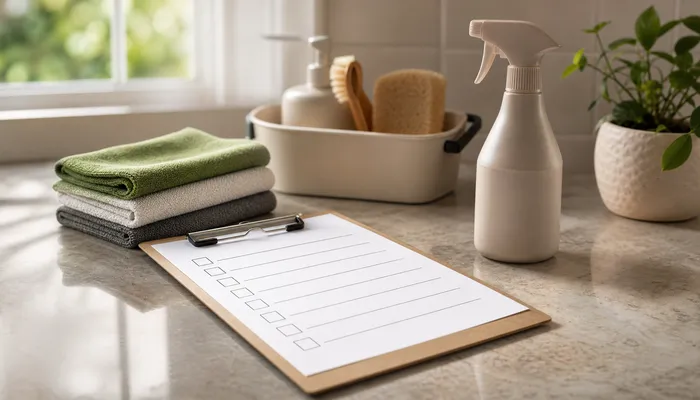
The last task before a crew leaves a home is rarely the most visible one. It is the walk-through: a crew member moves from kitchen to bathroom to bedroom with a clipboard, checking the same points in the same order, then notes anything that needs a second pass. That walk-through is where the Certified Clean Checklist does its real work. It is the company-side inspection document behind The Certified Clean Guarantee™, and it exists so what clean means is defined before the visit starts rather than argued about after the door closes.
Why a Written Checklist Changes the Result
A written checklist changes the result because it removes memory from the process. Without one, the standard is whatever the crew remembers, how much time is left, or which room looks worst at a glance. With one, the crew works from a fixed sequence: every room is checked against the same points, and a missed point is visible before the visit ends.
Quality control on a cleaning visit is not a survey sent days later. It happens while the crew is still on site, room by room, so a second pass can be made before the customer walks in. That is the practical difference between a cleaning inspection checklist and a vague promise of attention to detail. The checklist does not replace experience, but it gives experience a repeatable shape.
Room by Room: The Inspection Points That Matter
The Certified Clean Checklist is organized by room because a home is not one surface. A kitchen, a bathroom and a bedroom fail in different ways, and each needs its own inspection points. The order also matters: the crew works from the rooms that take the most contact to the rooms that are judged by sight and touch.
Kitchen
In the kitchen, the check moves from counters to sink and fixtures, then to the exterior of appliances and cabinet fronts. Floor edges and corners get a separate look because a clean center of the floor can hide a missed edge. Trash removal is confirmed before the room is signed off. The point is not to list every surface in a house; it is to check the places where a rushed pass shows first.
Bathrooms
Bathrooms are checked at fixture level: sink, faucet, toilet base and seat area, tub or shower surfaces, mirrors and visible grout lines. Towel and tissue placement are included because a bathroom can look unfinished even when the fixtures are clean. Floor edges around the toilet and vanity are inspected again, since those are common places for a quick pass to stop short.
Living and Sleeping Areas
Living and sleeping areas are checked at reachable heights, under furniture edges, on floors and around trash points. Dusting is judged by what a hand or a cloth can reach without moving heavy furniture, unless a specific arrangement was agreed for the visit. Beds, sofas and open surfaces are checked for visible marks and debris, not just for a quick wipe down the middle.
Detail Points That Reveal a Careless Pass
Some points are easy to skip and easy to inspect: switch plates, door handles, baseboards, light switches and the edges around mirrors. These are not the most glamorous parts of a clean, but they are the ones a customer notices when they are missed. The checklist keeps them in the sequence instead of leaving them to whoever has time at the end.
Who Performs the Check
The check is performed by the crew that cleaned the home, not by a separate inspector who never touched the room. Quick Cleaning crews are background-checked W-2 employees rather than freelancers, so the same standard is applied by people working inside the same company structure. That matters for a checklist: when the person checking is also accountable for the work, the checklist is less likely to become paperwork.
Supplies and equipment arrive with the crew, which keeps the inspection criteria consistent from visit to visit. If a product or tool is missing, the crew is not forced to substitute whatever is under the sink and then judge the result against a standard it could not meet.
The 24-Hour Follow-Up, Subject to Service Terms
Even with a checklist, a missed item can happen. The useful question is what the company does next. Quick Cleaning publishes a 24-hour missed-item follow-up, subject to service terms. In practice, that means a customer who notices something after the crew leaves should report it promptly, with the room and the specific item, so the office can review the visit and determine the next step allowed by the service terms.
The follow-up is not a promise of a refund or an outcome beyond what the terms state. It is a defined window for raising a concern while the details are still fresh. That distinction matters: a checklist supports accountability, but the service terms still govern what happens after a report is made.
Using the Checklist as a Customer
Customers do not need to memorize the inspection points. They only need to know that the checklist exists, that it is used on the company side, and that a missed item has a defined path. If you want to understand the difference between a checklist and experience, read why a checklist alone does not guarantee quality. If the crew has already left, what to check once the crew has finished gives you a practical walk-through from the customer side. And if something was missed, how to raise a missed item without awkwardness explains how to report it clearly.
If you are scheduling a visit and want to see what a scheduled clean includes, the service page explains the residential and commercial options available in Lake Forest. The Certified Clean Checklist is not a separate add-on; it is part of how a standard visit is reviewed before it is signed off.