An apartment cleaning checklist only works when it fits the apartment you actually live in. Across Chicago’s North Side and the near-north suburbs, that can mean a two-flat walk-up in Albany Park, a courtyard building in Rogers Park, a student rental in Evanston, a small multifamily property in Lincolnwood or a condo in Skokie. The rooms are usually the same; the access, the storage, the flooring and the season are not. Below is a checklist you can work through room by room, what changes for recurring, deep and move-out cleaning, and where to find the details that apply to your building.
Quick Cleaning has cleaned homes and businesses in Chicago and the surrounding communities since 2010. What carries across every building type is the sequence: our crews work from The Certified Clean Checklist, so the same inspection points get covered in a studio and in a three-bedroom.
Why Apartment Living Here Looks the Way It Does
Illinois is a Midwestern state with an estimated 12.7 million residents according to U.S. Census ACS five-year 2023 estimates, with Chicago as its largest city and Springfield as the capital. The state meets Lake Michigan at its northeast corner, and that geography shapes the housing as much as the weather does: dense multifamily blocks near transit, older walk-ups inside the city, and a ring of inner suburbs where small apartment buildings sit beside single-family homes.
That mix is why a generic list rarely survives contact with a real apartment. A building with a shared front door, four flights and no service elevator asks different questions than one with a loading zone and a reservable elevator. An apartment shared by two roommates, a dog and a work-from-home desk also needs a different rhythm than one occupied by a tenant who travels most weeks.
What Changes From One Building to the Next
Before products, the practical questions are about access. Is there a buzzer, a keypad, a lobby desk? Where can a crew park, and is there a hydrant or a permit zone in front? In Albany Park and Rogers Park, where many apartment buildings are older walk-ups with shared entries, those details decide how a visit is scheduled far more than square footage does.
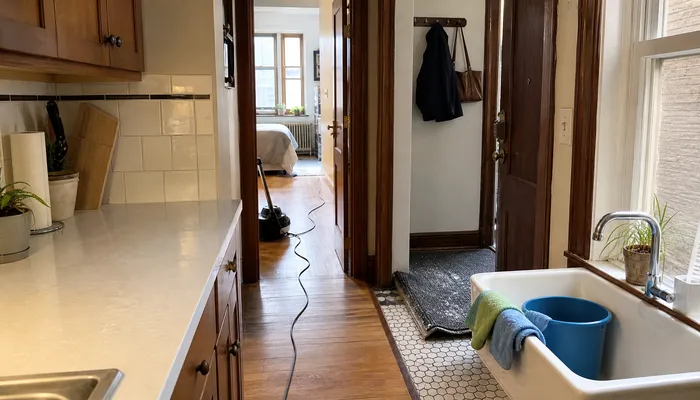
Inside the unit, the work shifts with the finishes. Painted wood cabinets, laminate counters, original tile and radiators that collect dust all ask for different handling than a newer build with quartz and recessed lighting. Add a roommate turnover, a pet or a home office, and priorities move again. That is why an apartment cleaning checklist is a starting point, not a script.
A Room-by-Room Apartment Cleaning Checklist
Work top to bottom, dry before wet, and from the farthest corner toward the door, so dust and floor debris finish where you can collect them.
Kitchen
- Clear the counters, then wipe the surface, the backsplash and the seam where crumbs collect.
- Clean the sink, the faucet and the rim of the basin, then dry the fixtures.
- Wipe cabinet fronts and handles, especially beside the refrigerator and the stove.
- Clean appliance exteriors, the microwave interior and the stovetop, including the drip pans.
- Take out trash and recycling, then clean the floor and the baseboard behind the bin.
Bathroom
- Apply cleaner to the tub, shower and toilet first so it has time to work.
- Scrub the toilet base, the floor around it and the hinges.
- Wipe the vanity, mirror and fixtures, then dry glass and chrome.
- Dust the exhaust vent cover and the top edge of the door frame.
- Finish with the floor, including the corners behind the door.
Bedroom and Living Areas
- Dust from the highest point down: ceiling corners, shelves, blinds, then furniture.
- Wipe light switches, door handles and remote controls.
- Vacuum upholstery and the floor under furniture where the vacuum reaches.
- Clean glass and mirrors, then vacuum or mop the floor last.
Dust indoors is not only a visual problem. The EPA’s indoor air quality guidance treats dust, moisture and ventilation as connected, which is why vent covers and bathroom exhaust fans belong on the list and not just the surfaces you can see.
Entry, Closets and Floors
- Wipe the inside of the entry door, the handles and the light switch.
- Shake out or vacuum the entry mat, then clean the floor beneath it.
- Sweep or vacuum closet floors and the track of sliding doors.
- Mop hard floors last, working toward the exit.
Recurring, Deep and Move-Out Cleaning Need Different Checklists
The room list above is the recurring version: maintenance cleaning for a space that is already lived in. A deep clean adds what is easy to postpone — inside the oven, behind and under movable furniture, grout lines, window tracks, baseboards, vent covers and cabinet interiors. A move-out clean assumes an empty unit and adds the inside of cabinets and drawers, the inside of the refrigerator and freezer, closet shelves, the balcony or landing, and whatever the next tenant opens first.
Timing matters as much as the list. If you are unsure whether your apartment needs a maintenance visit or a full reset, this guide on how often you should clean your apartment separates habit from deep work. In Evanston, where rentals turn over around the academic calendar, and in Lincolnwood, where a smaller village market means fewer units change hands at once, the practical question is usually the same: is the unit empty, and does anyone need it back by a certain date?
Supplies are the other variable. Some renters keep a short kit at home and want specific products used on certain surfaces; others prefer the crew to arrive with everything. If you are building a kit for touch-ups between visits, this list of indispensable products for cleaning an apartment covers the basics without duplicating what a professional visit already handles.
Winter Salt, Spring Grit and Seasonal Additions
Northeast Illinois weather writes its own checklist section. From November through March, salt, sand and slush travel from sidewalks and alleys into entryways, stairwells and the first few feet of every apartment. Add three items: a mat that actually traps grit, a quick pass on the entry floor before residue dries, and a wipe of the lower door and baseboards where splash marks land.
Spring flips the problem. Once street sweeping starts and the melt finishes, tracked-in grit gives way to pollen and open-window dust. That is the moment for the parts a weekly routine skips: window sills, blinds, the tops of cabinets and the radiator fins.
How the Checklist Applies Across the Region
The group this guide covers stretches from Chicago’s North Side community areas of Albany Park and Rogers Park out through the near-north suburbs. Albany Park’s rented two-flats and Rogers Park’s mix of courtyard buildings and lakefront high-rises put a premium on shared-entry coordination and stairwell access. Evanston, with an estimated 76,552 residents in the U.S. Census ACS five-year 2023 estimates, blends single-family blocks with dense rental pockets near transit. Lincolnwood, a village of roughly 13,179 by the same estimates, leans toward smaller multifamily and single-family properties. Skokie, at an estimated 66,427, carries a large multifamily share alongside single-family homes, and if you are comparing options there, the page on apartment and move-out cleaning in Skokie lays out the local service details.
Those figures are Census estimates and describe each place generally, never one specific building. What actually shapes a cleaning visit is narrower: unit size, condition, access and how often you want the work done.
Questions Renters and Owners Ask
How Long Should a Checklist Take to Complete?
It depends on the unit and its condition, not on the list. A studio that has been maintained moves quickly; a three-bedroom with pets, a recent move or a long gap between cleans takes considerably longer. The useful approach is to share bedrooms, bathrooms and condition when you book, then confirm the scope before the crew arrives.
Do I Need to Be Home During the Cleaning?
No. Many customers arrange access in advance — a key, a buzzer code or a building contact — and continue their day. If your building requires a certificate of insurance, a lobby check-in or a reserved elevator, mention it when booking so the schedule accounts for it.
Is a Move-Out Clean Different From a Regular Apartment Cleaning?
Yes. The move-out version assumes the unit is empty and adds cabinet interiors, the inside of appliances, closet shelves, the balcony or landing and the floors under where furniture used to sit. It is the checklist for the end of a lease, not the weekly one.
Do You Bring the Supplies and Equipment?
Our crews arrive with their own supplies and equipment as part of a standard visit. If you want particular products used on certain surfaces, or you keep something specific for a finish you care about, tell us when booking and we will work with it.
Which Areas Does This Guide Cover?
Albany Park, Rogers Park, Evanston, Lincolnwood and Skokie, plus the surrounding Chicago neighborhoods and near-north suburbs we serve. Availability is confirmed when you book rather than assumed from a map.
How Do I Get a Price for My Apartment?
Square footage, condition, frequency and add-ons are what move the number, and the final price is confirmed with a quote before the crew arrives. You can request a cleaning quote online or call +1 773-644-5568 to talk through the unit.
If you live in Albany Park, Rogers Park, Evanston, Lincolnwood or Skokie and you would rather hand the list to a crew than save it for a free weekend, start with the local details for your building and check what applies to your unit. If you simply want a written standard to hold yourself to between visits, keep the room order above — kitchen first while the bathroom cleaner works, floors last, entry at the very end — and the checklist will do its job.